


- Introduction to Web API
- Authorization
- Data types
- Data import
- Working with filters
- Working with filters in reports
- Additional field attributes
- Additional attributes of data short description
- Partial and eager loading of app fields
-
Public Web API
- Managing apps
-
Managing business processes
- Bulk interruption of process instances (POST)
- Bulk update of process instances (POST)
- Change the process instance context (PUT)
- Continuation of a delegated action by ID (POST)
- Get a list of process instances (POST)
- Get a list of process instances (POST)
- Get a list of process instances (GET)
- Get a list of process instances (GET)
- Get a list of process instances by target (GET)
- Get a list of process instances by target (POST)
- Get a process instance by ID (POST)
- Get a process instance by ID (GET)
- Interrupt a process instance (POST)
- Start process by workspace and code (POST)
- Update a process instance version (POST)
-
Managing files
- Bulk file deletion (PATCH)
- Bulk file initialization (POST)
- Bulk file upload via links (POST)
- Bulk receiving of file upload links (POST)
- Bulk retrieval of file download links (POST)
- Directory is created (POST)
- File search (POST)
- Get a list of directories (GET)
- Get a list of directories (POST)
- Get file download link by file ID (GET)
- Get file download link by file ID (POST)
- Get information about a directory by ID (GET)
- Load a file to a directory (POST)
- Moving a file to a directory (POST)
- Retrieving file information by ID (GET)
- Upload a temporary file (POST)
- Managing users
-
Working with metadata
- Adding org chart items to group (POST)
- Create a group’s metadata description (POST)
- Delete a group (DELETE)
- Deleting org chart items from group (POST)
- Edit group data (PUT)
- Get a group metadata description instance by ID (GET)
- Get a list of an app’s document templates’ metadata descriptions (GET)
- Get a list of document templates’ metadata descriptions (GET)
- Get a list of groups the specified group is included in (GET)
- Get a list of metadata descriptions of filtered groups (GET)
- Get a list of metadata descriptions of filtered groups (POST)
- Get a list of metadata descriptions of groups and roles by app (GET)
- Get a list of modules’ metadata descriptions (GET)
- Get a list of pages’ metadata descriptions (GET)
- Get a list of positions included in a group (GET)
- Get a list of process templates’ metadata descriptions by app (GET)
- Get a list of solutions’ metadata descriptions (GET)
- Get a list of sub-groups of a specified group (GET)
- Get a list of users included in a group (GET)
- Get app metadata description by code (GET)
- Get list of app metadata descriptions (GET)
- Get list of process tempalte metadata descriptions (GET)
- Get list of workspace metadata descriptions (GET)
- Get metadata descriptions of a module by ID (GET)
- Get process template metadata description by code (GET)
- Get the list of metadata descriptions of groups (GET)
- Get the metadata description of a document template by ID (GET)
- Get the metadata description of a page by ID (GET)
- Get the metadata description of a solution by code (GET)
- Get workspace metadata description by code (GET)
- Whether the app can be exported using its code (GET)
- Whether the module can be exported using its ID (GET)
- Whether the solution can be exported using its code (GET)
- Whether the workspace can be exported using its code (GET)
- Working with modules
- Working with contracts
- Working with reports
- Working with marketing
- Working with document registration
-
Working with arbitrary string data storage
- Deleting data by key from the System object storage (DELETE)
- Deleting data by key from the app storage (DELETE)
- Deleting data by key from the workspace or module storage (DELETE)
- Retrieving data by key from the System object storage (GET)
- Retrieving data by key from the app storage (GET)
- Retrieving data by key from the workspace or module storage (GET)
- Saving data by key to the System object storage (POST)
- Saving data by key to the app storage (POST)
- Saving data by key to the workspace or module storage (POST)
- Working with approval sheets and lists of informed users
- Working with registration
-
Working with tasks
- Changing task completion percentage (POST)
- Changing task dates (POST)
- Getting a list of incoming tasks (POST)
- Getting a list of incoming tasks (GET)
- Getting a list of outgoing tasks (POST)
- Getting a list of outgoing tasks (GET)
- Getting a list of outputs for task (GET)
- Getting a list of tasks (GET)
- Getting a list of tasks (POST)
- Getting a list of tasks in "Assisting" section (POST)
- Getting a list of tasks in the "Assisting" section (GET)
- Getting a list of user tasks (GET)
- Getting a list of user tasks (POST)
- Getting task by ID (GET)
- Task execution (PUT)
- Task reassignment (POST)
-
Working with messages
- Creating a comment on a channel message (POST)
- Creating a comment on an object activity stream message (POST)
- Creating a new message in the channel (POST)
- Creating a new message in the object activity stream (POST)
- Getting a list of channels (GET)
- Getting a list of comments for a message from the channel (POST)
- Getting a list of comments for a message from the channel (GET)
- Getting a list of comments for a message from the object's activity stream (GET)
- Getting a list of comments for a message from the object's activity stream (POST)
- Getting a list of messages from the channel (GET)
- Getting a list of messages from the channel (POST)
- Getting a list of messages from the object's activity stream (GET)
- Getting a list of messages from the object's activity stream (POST)
- OpenAPI specification
Introduction to Web API
Web API is a set of tools for integrating the platform with external systems.
General information
- The API works via the HTTPS protocol using HTTP requests such as
POST,GET,PUT, etc. - Authorization is performed via a token.
- All the data is available only in the JSON format.
- The base URL is
https://{company}.brix365.eu/pub/v1. - Data queries are possible from any system.
You can learn about all available API methods in the Public Web API article.
If needed, you can also add your own API methods using custom modules. Read more about it in the official BRIX documentation.
Testing requests
You can check whether your request is valid in BRIX. To do this, open the list of main API methods available for a component:
For an app, contract, or report: click the gear icon next to its name. In the menu that appears, select API.
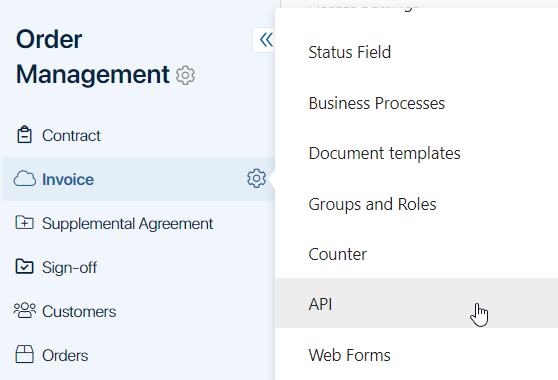
For a process: in the business process designer, open the Settings > API tab.
In the list that opens, expand the block containing the API method you want to test. During testing, you can specify input values or compose the request body using a predefined template. You will receive:
- The request URL including the path parameters.
- The server’s response code and body.
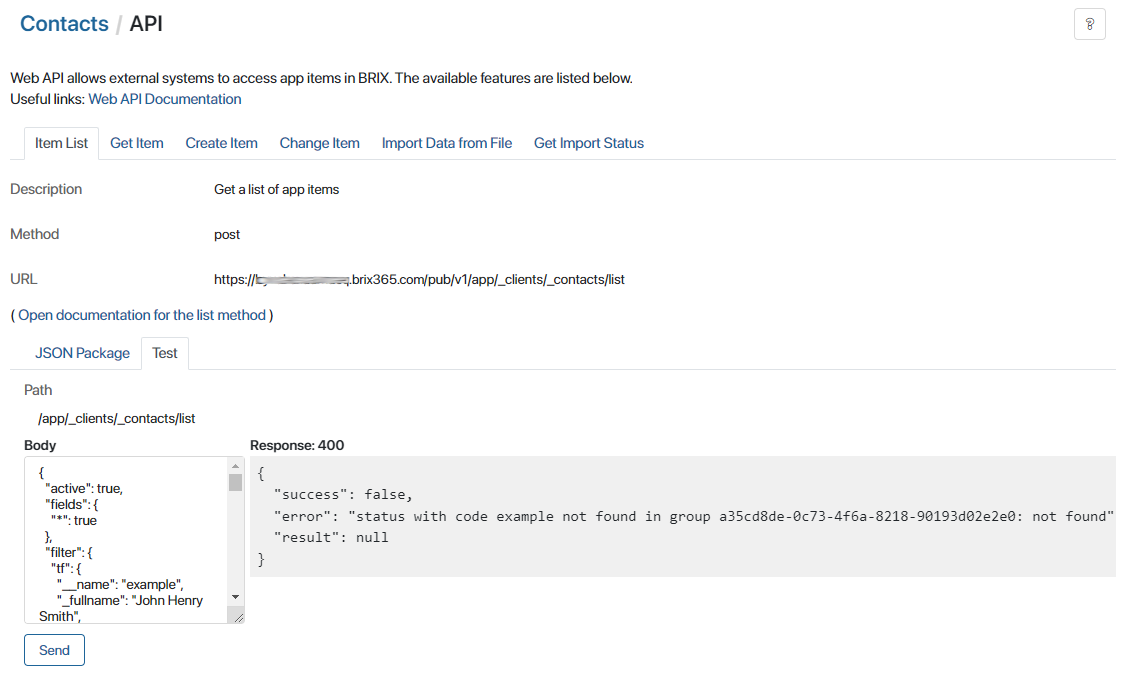
Please note that test requests are executed in the system. For example, when testing API methods for creating or editing app items, the data will actually be modified.
For more information, see the official BRIX documentation.